5.8 Balanced Binary Tree
5.8.1 Problem Metadata
- Platform: LeetCode
- Problem ID: 110
- Difficulty: Easy
- URL: https://leetcode.com/problems/lc-balanced-binary-tree/
- Tags: Grind 75, NeetCode 150
- Techniques: Depth First Search, Recursion, Tree, Binary Tree
5.8.2 Description
Given a binary tree, determine if it is height-balanced.
For this problem, a height-balanced binary tree is defined as:
A binary tree in which the depth of the two subtrees of every node never differ by more than 1.
5.8.3 Examples
Example 1:
Figure 5.2: Balanced tree example
Input: root = [3,9,20,null,null,15,7]
Output: true
Explanation: Height of left subtree = 1, height of right subtree = 2, difference = 1 (balanced)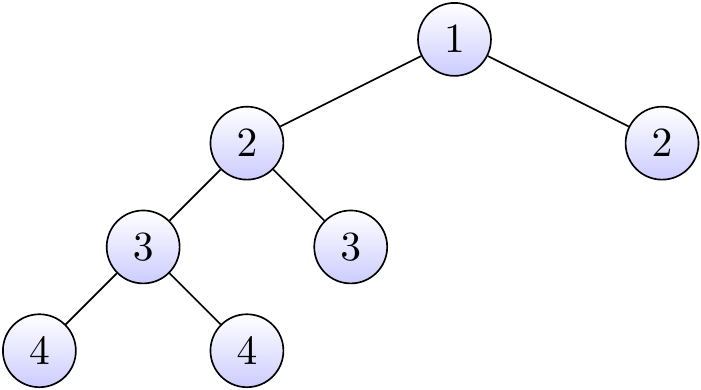
Figure 5.3: Unbalanced tree example
Input: root = [1,2,2,3,3,null,null,4,4]
Output: false
Explanation: Left subtree has much greater depth than right subtree
Example 3:
Input: root = []
Output: true
5.8.4 Constraints
- The number of nodes in the tree is in the range
[0, 5000] -10^4 <= Node.val <= 10^4
5.8.5 Solution - Recursive DFS
5.8.5.1 Walkthrough
Use a recursive depth-first search to compute the height of each subtree.
For each node:
1. Recursively compute the height of the left subtree
2. Recursively compute the height of the right subtree
3. Check if the absolute difference between heights is greater than 1
4. If unbalanced at any node, propagate -1 upward to indicate imbalance
5. Otherwise, return the maximum height + 1
The key insight is to combine height calculation with balance checking in a single pass.
5.8.5.2 Analysis
- Time Complexity: O(n) - Each node is visited exactly once
- Space Complexity: O(h) - Recursion call stack depth equals tree height h, where h can be log(n) for balanced trees or n for skewed trees
5.8.5.3 Implementation Steps
- If root is null, return 0 (base case)
- Recursively get height of left subtree:
lHeight = getHeight(root.left) - Recursively get height of right subtree:
rHeight = getHeight(root.right) - If either subtree returned -1 (unbalanced), propagate -1 upward
- If
|lHeight - rHeight| > 1, return -1 (unbalanced) - Otherwise, return
max(lHeight, rHeight) + 1
5.8.5.4 Code - Java
public boolean isBalanced(TreeNode root) {
    return getHeight(root) != -1;
}

private int getHeight(TreeNode root) {
    if (root == null) {
        return 0;
    }

    int lHeight = getHeight(root.left);
    int rHeight = getHeight(root.right);

    // If left or right subtree is unbalanced, propagate -1
    if (lHeight == -1 || rHeight == -1) {
        return -1;
    }

    // If current node is unbalanced, return -1
    if (Math.abs(lHeight - rHeight) > 1) {
        return -1;
    }

    // Return height of current subtree
    return Math.max(lHeight, rHeight) + 1;
}
5.8.5.5 Code - Golang
func isBalanced(root *TreeNode) bool {
    if root == nil {
        return true
    }

    return dfs(root) != -1
}

func dfs(node *TreeNode) int {
    if node == nil {
        return 0
    }

    lHeight := dfs(node.Left)
    rHeight := dfs(node.Right)

    // If left or right subtree is unbalanced, return -1
    if lHeight == -1 || rHeight == -1 {
        return -1
    }

    // If current node is unbalanced, return -1
    if math.Abs(float64(lHeight - rHeight)) > 1 {
        return -1
    }

    // return height of current subtree
    return max(lHeight, rHeight) + 1
}