5.19 Two Sum IV - Input is a BST
5.19.1 Problem Metadata
- Platform: LeetCode
- Problem ID: 653
- Difficulty: Easy
- URL: https://leetcode.com/problems/two-sum-iv-input-is-a-bst/
- Tags:
- Techniques: Depth First Search, Hash Table, Tree, Binary Search Tree
5.19.2 Description
Given the root of a Binary Search Tree and an integer k, return true if there exist two distinct nodes whose values sum to k. Otherwise, return false.
5.19.3 Examples
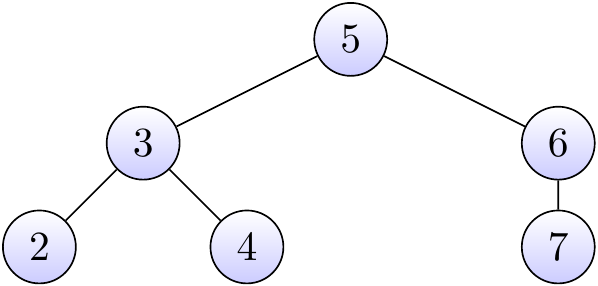
Figure 5.4: BST used in the example.
Input: root = [5,3,6,2,4,null,7], k = 9
Output: true
Explanation: 2 + 7 = 9.
5.19.4 Constraints
1 <= nodes <= 10^4-10^4 <= Node.val <= 10^4- BST property holds for the entire tree
5.19.5 Solution - DFS + HashSet
5.19.5.1 Walkthrough
Traverse the tree with DFS while maintaining a set of seen node values. For each node:
- Compute
needed = k - node.val. - If
neededis already in the set, returntrue. - Otherwise, insert
node.valand continue exploring the left and right subtrees.
Because every value is checked exactly once, the traversal stays linear.
5.19.5.2 Analysis
- Time Complexity: O(n) - Visit each node exactly once
- Space Complexity: O(n) - HashSet stores up to n values + O(h) recursion stack where h is tree height
Why Not Use BST Property? While we could use in-order traversal to get sorted values and then apply two pointers, the DFS + HashSet approach is simpler and has the same O(n) time complexity.
BST-Specific Optimization: Could implement bidirectional BST iterator (one forward, one backward) for O(h) space instead of O(n), but added complexity rarely justifies the space savings.
Trade-off: We sacrifice O(n) space for code simplicity. The BST property doesn’t provide significant advantage over treating it as a general binary tree for this problem.
5.19.5.3 Implementation Steps
- Initialize an empty
HashSet<Integer>. - Perform DFS:
- If the node is
null, returnfalse. - If
setcontainsk - node.val, returntrue. - Add
node.valto the set. - Recurse into left or right subtrees; return
trueif either side finds a match.
- If the node is
- Return
falseif no pair exists.
5.19.5.4 Code - Java
public boolean findTarget(TreeNode root, int k) {
    return dfs(root, k, new HashSet<>());
}

private boolean dfs(TreeNode node, int target, Set<Integer> seen) {
    if (node == null) {
        return false;
    }

    int needed = target - node.val;
    if (seen.contains(needed)) {
        return true;
    }

    seen.add(node.val);
    return dfs(node.left, target, seen) || dfs(node.right, target, seen);
}